Showing posts with label Fiction picturebook. Show all posts

Saturday, March 22, 2014

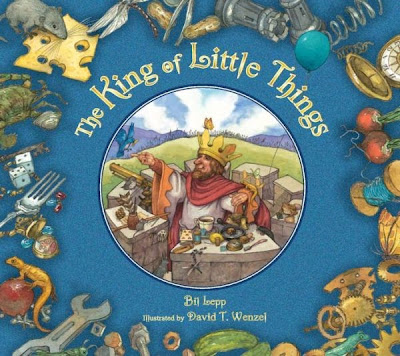
The King of Little Things


 https://blogger.googleusercontent.com/img/b/R29vZ2xl/AVvXsEiAoQaFvbo5-U6_By2rqaYaf_BZ2QPrue2-wv1MOzvfQBxIWgKMLWrYsIXYmnH-SR1WF4gdk42D1NLfFYoK4s8IVxEIlPMlKTB-K415jcLssbktoA232dwutK8696Uq69kLMZUSLb6JHic/s1600/King.JPG

Lepp, Bil, and David Wenzel. The King of Little Things. Atlanta: Peachtree, 2013. Print.

 ISBN:   978-1-56145-708-3

Audience: Ages 4-8, Grade PK-3

Summary:  In this original fairy tale, King Normous wants to be the Ruler of All the World and only the King of Little Things stands in the way of his plans. However, when he attacks the Little Kingdom the king, who “has all he needs and doesn’t need more,” doesn’t back down. His loyal subjects back him by fighting back and then continue to support him even after he is imprisoned. When the little things strike against him, King Normous realizes that little things do matter after all.

Strengths:  This book introduces unfamiliar vocabulary in a way that makes it accessible and fun. Lepp is also a master of figurative language, who manages to weave in alliteration, metaphors, similes, and rhythm without ever losing the narrative storyline. Wenzel’s illustrations include amazing detail and highlight the humor in Lepp’s tale. This book is a joy to read!

Weaknesses: I feel the recommended ages for this book should be expanded. While it would be appropriate for younger grades as a read aloud or a genre example, it could easily be used in the upper elementary grades for an exemplar text. The language is masterful and much of the vocabulary is grade-level appropriate for older students.

Uses:  This book would work well for a genre story on fairy tales and fables (CCSS ELA:RL.2 Grades 2- 4) or a discussion of themes (CCSS ELA: RL.2 Grades K-6). The expressive language and vocabulary would make it a perfect mentor text for writing (CCSS ELA:L.4 Grades 3-5 and CCSS ELA:W.3 Grades K-6) as well as one to take apart for an in-depth study of figurative language (CCSS ELA:L.5 Grades 1-6).

Read-alikes:
  • The Three Pigs -   David Wiesner (Wiesner’s unique take on the traditional tale)
  • The Lion & the Mouse- Jerry Pinkney (A familiar story with a similar theme)  
  • The Once Upon a Time Map Book- B.G. Hennessey (Detailed maps of fairy tale lands.)    
  • The Teacher in the Patriotic Bathing Suit – Bil Lepp   (Audio recording of the author telling stories.)

Awards: 
Parent’s Choice Gold
Bank Street Best Books finalist

Other:  Starred review in Kirkus

Journey


 http://www.indyweek.com/binary/81b1/1388557962-journey_cover.jpg


Becker, Aaron. Journey. Somerville, Massachusetts: Candlewick Press, 2013. Print. 
ISBN:  0763660531
Audience: Ages 4-8, Grade PK-3

Summary: In this wordless picture book, a young girl tries to get her busy family to interact with her. The beginning spreads are dull with a almost colorless palette, broken only by a few touches of color created by the girl’s red crayon. When she fails, she uses her crayon to draw a door on her bedroom wall and goes through it into another magical world. The palette turns green and blue and the pages explode with light. Everything the girl draws magically becomes solid, and she explores the new world with the help of the transportation (boat, balloon, carpet, bicycle) that she creates. When an evil king captures her, a mysterious purple bird appears, and she follows it to a satisfying escape and solution to her loneliness.

Strengths: This wildly creative book would encourage any child to use their imagination – I think they would immediately be drawn into dreaming up new adventures for the main character. The wonderfully illustrated book is a feast for the eyes. The spreads are gorgeous and full of detail that made me want to stare at it for hours. That Becker was able to create such detailed illustrations with pen and ink and watercolor is truly amazing.

Weaknesses: At times, students can be frustrated by wordless books and feel that they are too “babyish.” They are a hard sell to teachers, as well, who often don’t know how to effectively use a book that they can’t use as a traditional read aloud.

Uses: A wordless book can be used to develop students’ ability to notice key details (Common Core State Standard ELA:RL.1 Grades K-3) by discussing what they see as they “read” the story and then transferring these details to writing their own narratives (CCSS ELA:W.3 Grades K-4). It also is a perfect venue for retelling of a story (CCSS ELA: RL.2 Grades K-2) and identifying literary structure (CCSS ELA: RL.5 Grades 2-5). An Art teacher could also use this book to discuss technique and color palette. Themes (CCSS ELA: RL.2 Grades K-6) include loneliness, adventure, and creativity. Finally, this book would be a great one to put in the hands of an ESL student or a reluctant reader who could understand the story.

Read-alikes:
·      Harold & the Purple Crayon - Crockett Johnson (The classic story of a boy who uses a purple crayon to draw things that come to life.)
·      Castle- David Macaulay (Intricate illustrations of castles)
·      hello! hello! – Matthew Cordell (The family is too busy to spend time with their daughter because of their digital devices.)
·      Blackout- John Rocco (The family is too busy to spend time together until a blackout hits the city.)
·      The Red Balloon   - (The classic Academy Award winning 1956 film of a boy who follows a red balloon through Paris.)

Awards: 
Caldecott Honor
Amazon Best Books
NYT Best Illustrated
Junior Library Guild

Other:  Starred reviews in Kirkus, Booklist, School Library Journal,  & Publisher’s Weekly, featured on Calling Caldecott

Resources for Librarians & Teachers:
Book Trailer: http://www.youtube.com/watch?v=SxUs41jB4Ts